
Locking your bike “quickly” is rarely enough. Opportunistic thieves mostly exploit common mistakes: a poor anchor point, an unsecured frame, a badly positioned lock… Here you’ll find a clear method, scenarios for your situation, and a quick checklist.
In 30 seconds: the most effective method (remember this)
- 1) Choose a visible, busy place (avoid isolated corners).
- 2) Lock it to a solid fixed object (ideally a bike rack).
- 3) With a U-lock, secure the frame + rear wheel to the fixed object.
- 4) If possible, add a second lock (chain/U-lock) for the front wheel.
- 5) Keep the lock off the ground and make it hard to access.
Goal: make theft take longer, create noise and raise the risk → the thief moves on to the next bike.
Contents
- Choose the right place (half the security)
- Step-by-step method (frame, wheels, lock)
- Choose the right technique for your equipment
- Special cases: e-bikes, long-term parking, at home
- Critical mistakes to avoid
- Checklist + recap video
- FAQ
1) Choose the right place: where securing your bike really begins
Even an excellent lock is a poor choice in an isolated place. The right approach is: visibility + foot traffic + a solid fixed object.
Tip A — Choose a busy, visible place

- Choose: main streets, shopping areas, metro exits, well-lit areas.
- Avoid: quiet lanes, corners, poorly visible car parks, backyards.
- Bonus: choose a place where there are other bikes (you blend into the crowd).
Tip B — Lock it to something that cannot move (really)
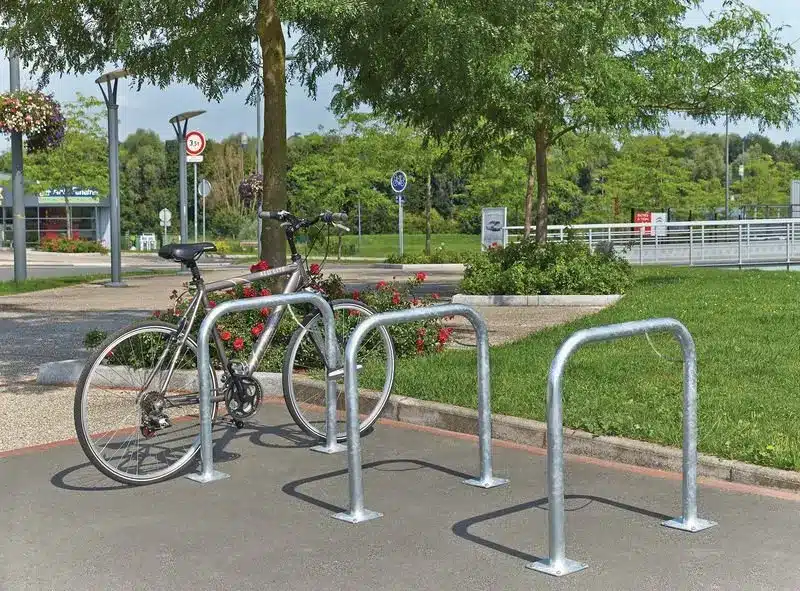
Best choice: a bike rack (or designated bike parking). If none is available, choose a support that is high, thick and permanently fixed.
- Check that your bike cannot be lifted over the support.
- Avoid: fences, wire mesh, flimsy supports, short posts, removable objects.
- One thing to watch: some supports may have been weakened (for example, cut into). If anything looks suspicious, choose another place.
Tip C — Don’t reveal how long you’ll be away
Parking right outside a stadium, cinema or event gives a clear clue: “this bike will be here for a long time”. If possible, park a few streets away, still somewhere visible.
Tip D — Extra precautions (marking, accessories, high-risk areas)
- If you know an area is risky, avoid leaving your bike there for long (or choose another option).
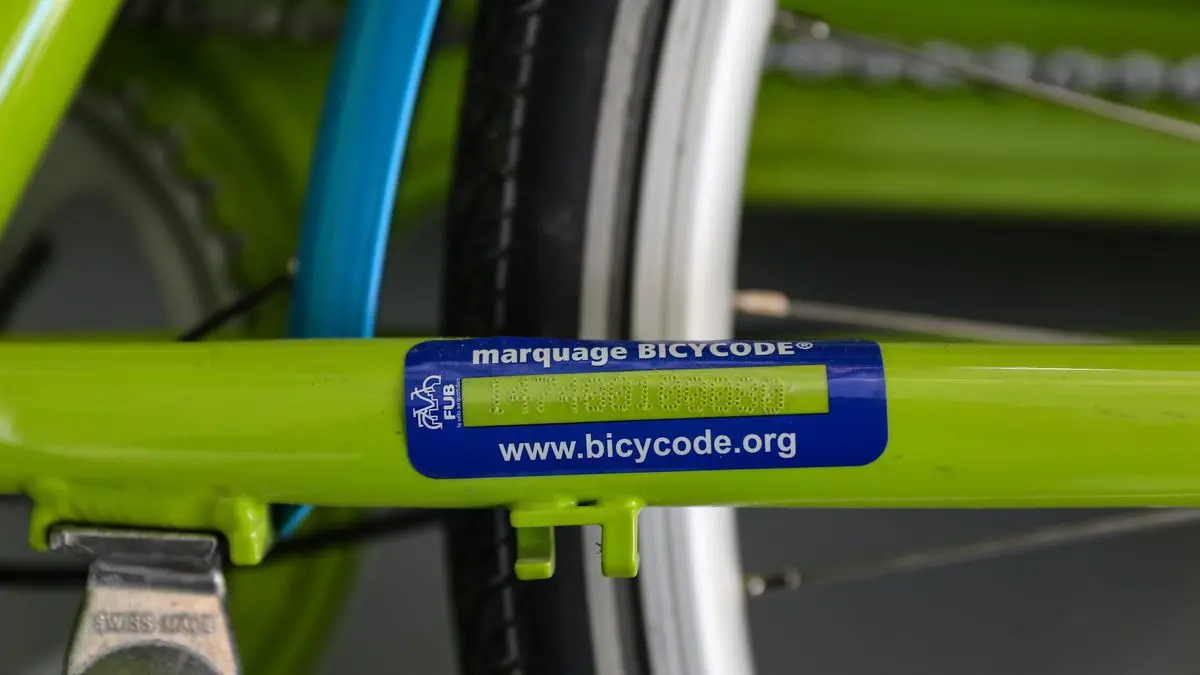
- Consider bike marking: an identifiable bike is less “easy” to resell.
- Remove accessories: lights, pannier, computer, phone mount (and the battery on an e-bike).
2) How to lock your bike properly: step by step
Now let’s move from “where” to “how.” The golden rule is: always secure the frame, and, if possible, both wheels.
Step 1 — Lock the frame (and ideally the rear wheel)

Bikes are still too often locked by the front wheel alone… The result: the bike disappears and a “sad” wheel is left on the rack.
- With one lock: frame + rear wheel secured to the fixed object.
- With two locks: add the front wheel.
Step 2 — Keep the lock off the ground
Don’t leave the lock on the ground: it can make some attacks easier (impacts, leverage, tools). Place it higher up or against an obstacle instead.
Step 3 — Make the lock hard to access
Point the keyway down and/or toward the frame/support to make tampering harder. The harder it is to reach, the more difficult (and risky) it is for a thief.
Step 4 — If you use a U-lock, fill as much of its interior as possible
The more empty space inside the U, the easier it may be to try leverage. Try to fill the U with the frame, wheel and support (without clamping fragile parts).
3) Choose the right technique for your equipment
The best technique depends on what you have with you. Here are the three most common cases, from most secure to most improvised.
Option 1 — Two locks (recommended): frame + both wheels
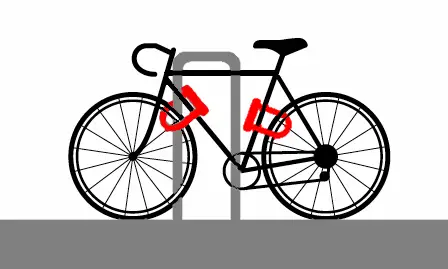
- Lock 1: frame + rear wheel to the fixed object.
- Lock 2: front wheel to the fixed object (or to the frame, depending on the support).
- Useful idea: combine two types (U-lock + chain) to make it harder for a thief to use their tools.
Option 2 — A U-lock + a cable (convenient, but less robust)
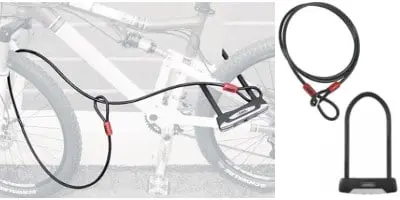
- The U-lock secures: frame + rear wheel to the fixed object.
- The cable secures: front wheel (as an extra).
- Note: a cable is easier to cut than a rigid lock → reserve it for shorter stops.
Option 3 — One lock and the front wheel removed (a very effective fallback)
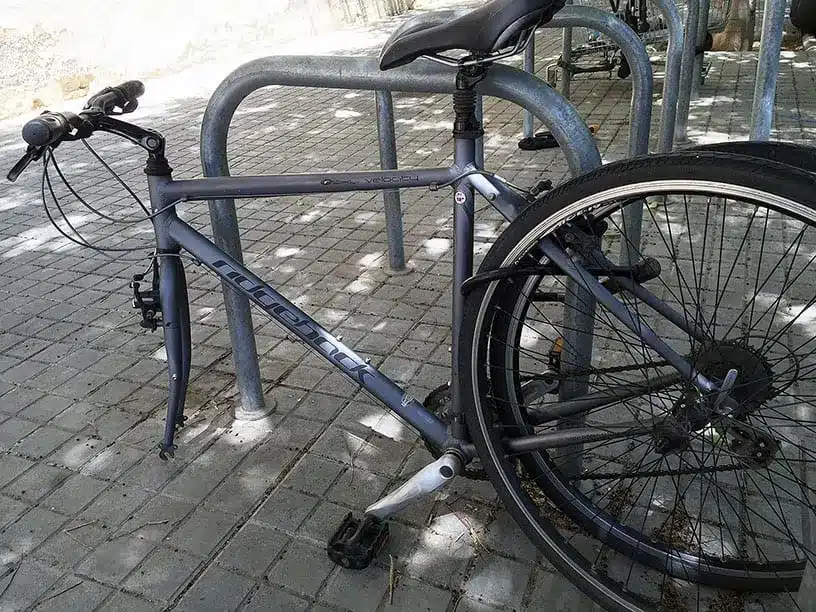
If you don’t have a second lock, removing the front wheel and securing it with the rear can be a hassle… but it’s an excellent way to make the bike harder to steal.
4) What level of security suits your situation? (practical table)
| Situation | What to do | Recommended minimum |
|---|---|---|
| 2–5 minute stop (bakery) | Frame + rear wheel secured to a fixed object, in a visible place | 1 U-lock |
| 1–2 hours in town (shopping / restaurant) | Frame + rear wheel + fixed object + lock off the ground | U-lock + cable (or two locks) |
| Station / long-term parking | Two locks + lit area + solid fixed object | Two locks (U-lock + chain) |
| E-bike (electric bike) | Remove battery/display + two locks + busy area | Two locks + remove accessories |
| At home (garage / cellar / storage room) | Still lock it to a fixed object + avoid leaving it “unsecured” | Anchor point + lock |
5) Special cases: e-bikes, long-term parking, at home
Electric bike (e-bike): what else to do
- Remove the battery and accessories (display, smartphone mount).
- Choose two locks and a very solid fixed object.
- If you can, avoid the routine of “same place, same time” (a thief may notice the pattern).
Long-term parking: technique is not enough; the location matters
If you have to leave your bike for a long time (station, work, overnight), the best protection is: secure bike parking (a lockable shelter, bike box or properly equipped room).
For a train journey, also see our guide to finding bike parking at a station : location, access, opening hours and price.
You lock your bike properly… but sometimes leave it outside for a long time?
In that case, the real game changer is being able to park in a secure enclosed space. At ByCommute, we design bike parking solutions (boxes / shelters / secure spaces) to reduce theft risk, especially at places used regularly (work, home, equipped sites).
Practical advice for your situation: duration, location and level of risk.
6) Critical mistakes to avoid at all costs
- Locking only the front wheel (the frame can be taken in five seconds).
- Using a cable on its own (it deters few thieves and is easy to cut).
- Leaving the lock on the ground (tools and leverage are easier to use).
- Choosing a “weak” fixed object (short post, wire mesh, fence).
- Leaving accessories / e-bike battery (they attract attention and increase your loss).
7) Quick checklist (before you leave)
- ✅ Solid fixed object (ideally a rack) and visible area
- ✅ Frame + rear wheel secured
- ✅ Lock off the ground and hard to access
- ✅ If possible: second lock or cable for the front wheel
- ✅ Accessories removed (e-bike: battery/display)
Need a quick recap? (video)
FAQ: locking your bike
Priority: frame + rear wheel secured to the fixed object. If your front wheel is easy to remove, the most effective fallback is to remove it and secure it with the rear wheel.
No. A cable lock alone is rarely a deterrent. It can be used as an extra with a U-lock (for example, for the front wheel), but not as the main protection.
On the ground, the lock can be easier to attack (leverage, impacts, tools). Keep it higher up and make the keyway hard to access.
Remove the battery and accessories, ideally use two locks, and choose visible areas. If you park for a long time, look for a secure space (bike box / lockable shelter).
Look for a high, solid, permanently fixed object and check that the bike cannot be lifted over it. Avoid fences/wire mesh and posts that are too short.
Conclusion: the best protection is a simple routine
Remember the essentials: the right place + a solid fixed object + the frame secured + a well-positioned lock. If you park for a long time (station, overnight, work), the most reliable option is secure bike parking.